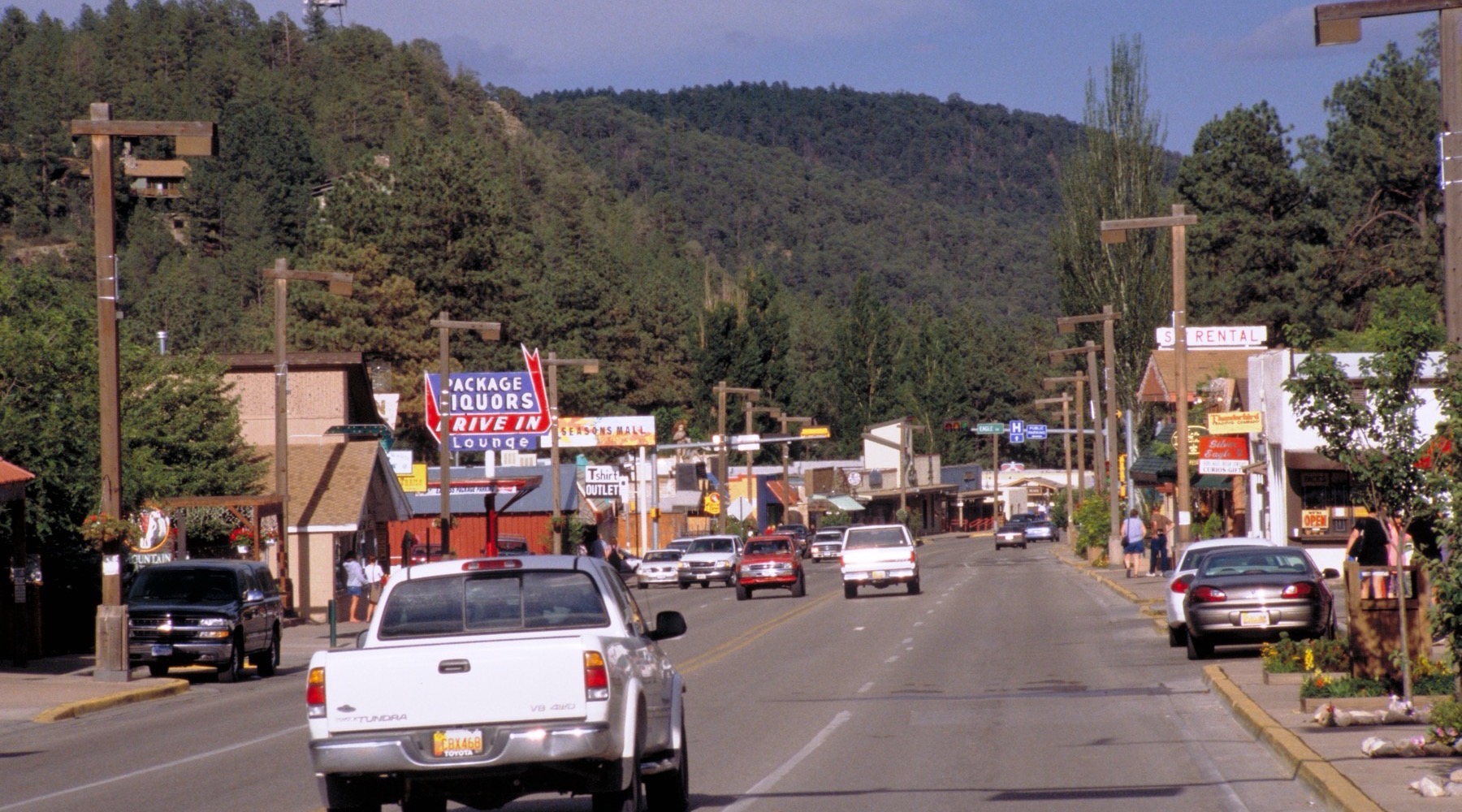
Usually not by itself. Business income coverage, the part of a commercial policy that replaces lost income while a business can’t operate, typically starts with physical damage to covered property. A road that is closed, a slow week after a storm, or a highway detour that keeps tourists away doesn’t usually trigger it on its own. Two related coverages can come into play, civil authority and access coverage, but each has conditions that are worth knowing before the day you need them.
Why does this matter so much in Ruidoso?
Our local economy depends on people being able to drive in. Bureau of Labor Statistics data for 2025 shows leisure and hospitality, meaning restaurants, lodging, recreation and the like, made up about 32% of private-sector jobs in Lincoln County. Statewide that share is about 14%, and nationally about 13%. When US-70 or NM-48 is closed, a lot of Sudderth Drive feels it the same afternoon.
How does business income coverage typically work?
Most commercial property policies of this type handle business income like this:
- Something physical has to happen first. Fire, wind, a burst pipe or another covered cause damages the building or equipment.
- The business has to actually slow down or close because of that damage.
- The coverage pays for a defined period, usually the time reasonably needed to repair, sometimes with a short extension afterward.
- A waiting period often applies, commonly measured in hours, before lost income counts.
The part that surprises people: business income is usually tied to the business’s own property. If the shop is untouched and the customers simply aren’t coming, most policies don’t treat that as a loss.
What is civil authority coverage?
Civil authority coverage, included in many commercial property forms, typically responds when a government order prohibits access to the business because of damage to property nearby. The usual conditions:
- There has to be an order, not just a closed road or a bad forecast.
- The order has to be tied to damage from a covered cause to other property, often within a set distance.
- There is usually a waiting period, often a few days.
- It runs for a limited time, often a few weeks at most.
A road closed for snow, a closure for construction, or an order issued purely as a precaution may not meet those conditions. Policies vary on this more than people expect, and the wording is specific.
What about access and utility coverage?
Some policies offer ingress and egress coverage, which addresses situations where the way into the business is physically blocked even without a government order. Others offer utility service interruption coverage, which can respond when power, water or gas goes out because of damage away from the premises. Both are typically written as endorsements, and the triggers, limits and waiting periods differ from one to the next.
For a business on Sudderth Drive or out near the Ruidoso Downs Race Track, the question worth asking is what happens if the power goes out for two days in July, or if the road in is blocked for a week.
The honest limit
Here is the part nobody likes to hear: no common business policy is designed to replace income from a slow season, a drop in tourism, or customers who stay home because they are nervous about the weather. Insurance is built around a specific, sudden event. A lot of what hurts mountain businesses is gradual, and that sits outside what most policies of this type are written to do.
If you run a short-term rental, our post on insuring a Ruidoso short-term rental cabin covers the lost-rent version of this question.
What to look at in your own policy
Read the declarations page for business income and its limit, then look for the words civil authority, ingress or egress, and utility services in the forms and endorsements. Note any waiting periods in hours or days. Your policy is the thing that answers this, and it is easier to read on a quiet Tuesday than the week something happens.
If you’d like us to read through it with you, see our business insurance page, call (575) 434-2719, or start a quote. We work with shops, restaurants and lodging owners across Ruidoso and Lincoln County.
This article is general information about how coverage typically works, not advice about your specific situation. Every policy reads a little differently, and yours is the only thing that says what you have. If you’d like someone to read it with you, call our Sudderth Drive office — that’s what we’re here for.